 About us
 Current Campaigns
 Start a petition
 Donate
How All Out helped turn Hungary’s pride ban into a defining EU rights test
Hungary’s ban on Pride marches violates freedom of assembly, equality, and EU law. The All Out community played a central role in challenging Hungary’s Pride ban, mobilizing public pressure, legal scrutiny, and international attention.In 2025, Hungary crossed a line. By banning Pride marches and criminalizing their organizers, the government restricted the right to peaceful assembly in a way unseen in any other European Union country. The move transformed Pride from a cultural celebration into a test case for fundamental freedoms, equality before the law, and the EU’s capacity to defend its own legal order.
From the moment the law was adopted in March 2025, All Out worked with local partners to frame the ban not as a political dispute, but as a clear breach of European Union law. The legislation expanded Hungary’s 2021 restrictions on information and expression by directly targeting public gatherings. Under the new rules, participants faced fines, organizers risked prison sentences, and police were authorized to use facial recognition technology against protesters.
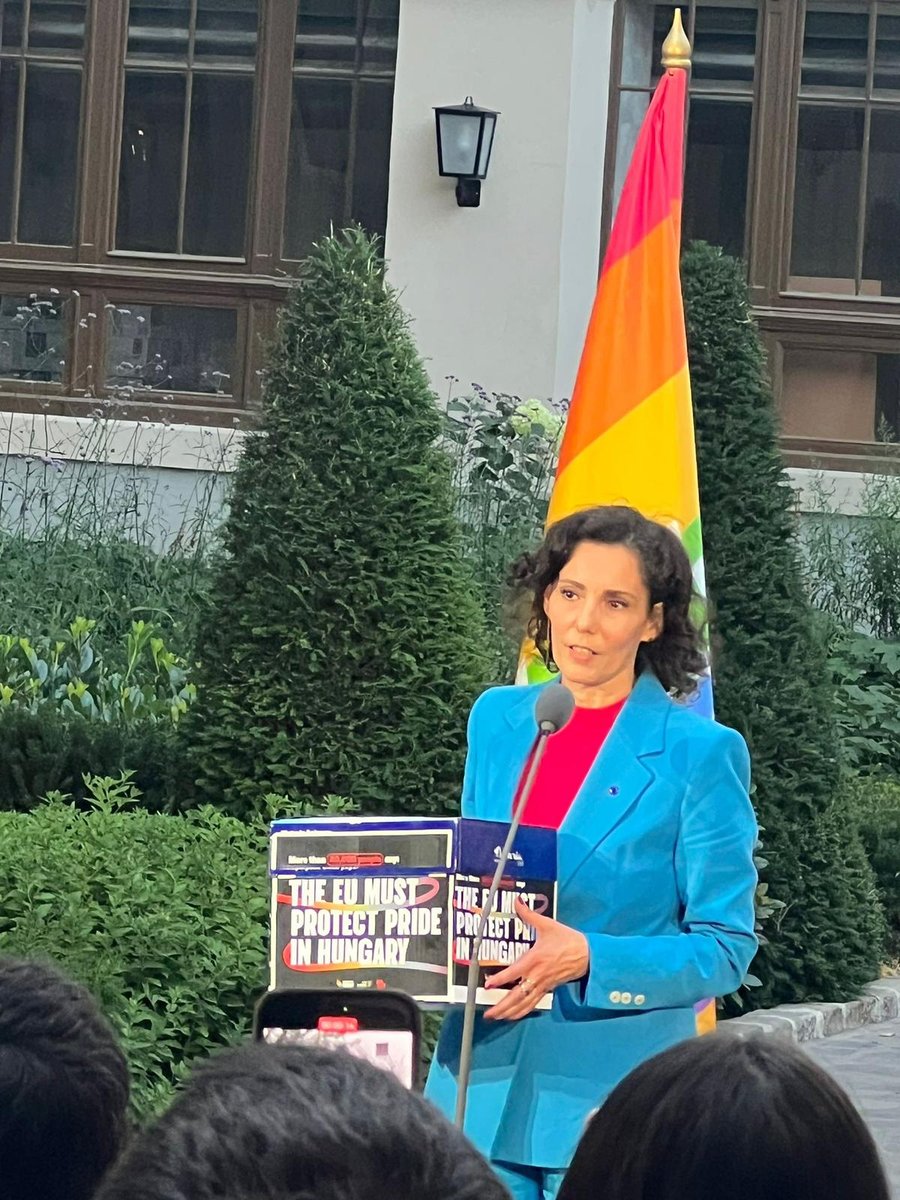
All Out’s first priority was to ensure the scale and consequences of the law were visible beyond Hungary. Through a global petition, the campaign gathered more than 40,000 signatures demanding that the European Commission intervene. The signatures were formally handed to EU Commissioner Hadja Lahbib in Budapest City Hall, creating a direct institutional record that citizens across Europe viewed the ban as unlawful.
The voices of All Out members mattered. Within days, the issue moved from domestic enforcement to the EU level. European Commission President Ursula von der Leyen publicly acknowledged that Hungary’s Pride ban violated fundamental freedoms, a position echoed by multiple commissioners. Budapest Pride’s campaign helped demonstrate that the same legal framework was now being used to criminalize assembly itself.
By early summer, the Advocate General of the Court of Justice of the European Union concluded that Hungary’s 2021 law violated EU law on multiple grounds, including discrimination and unjustified restrictions on expression.
Alongside legal pressure, All Out focused on visibility. On the eve of Budapest Pride’s 30th anniversary, messages were projected onto the National Assembly Office Building, transforming one of Hungary’s most prominent state landmarks into a public record of dissent withtatements such as “We are here. We are home.” and “Pride was, is, will always be.”

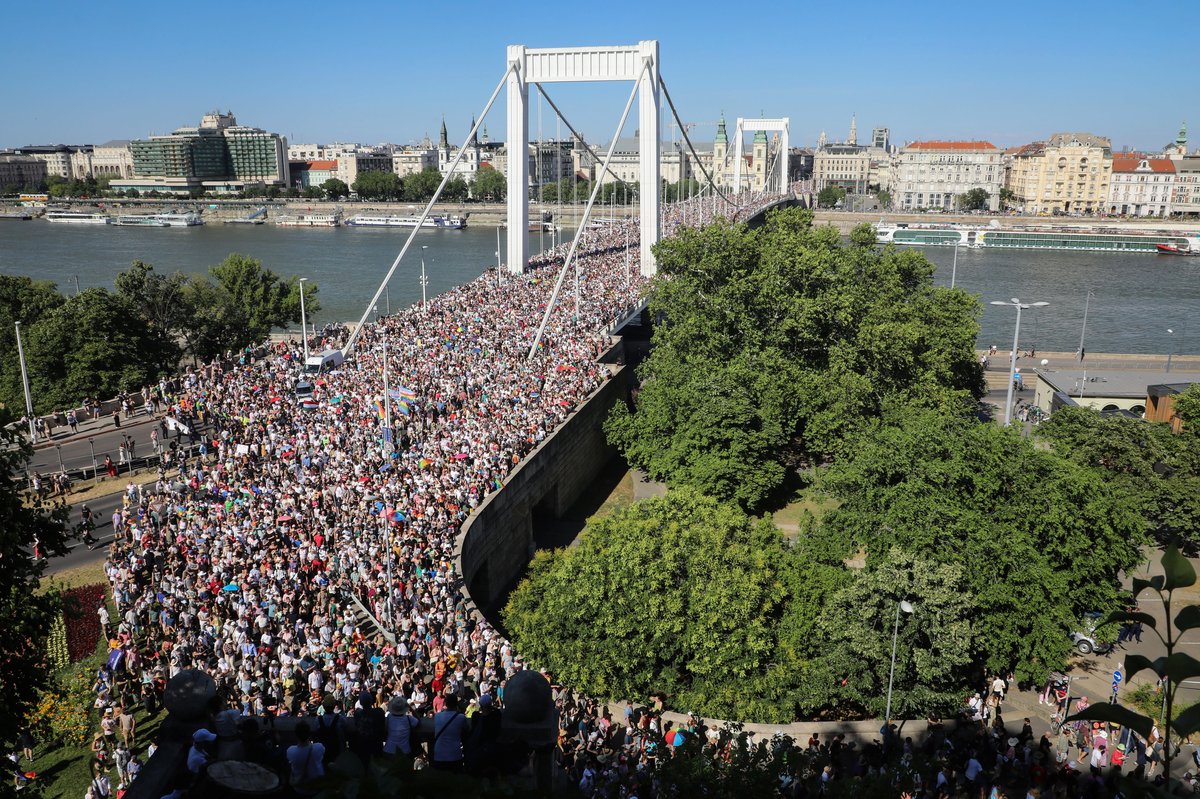
These actions coincided with a decisive moment. Despite repeated police bans and administrative delays, hundreds of thousands of people marched through Budapest on June 28, making it the largest Pride event in Hungary’s history.
In August, Budapest’s mayor was questioned by police for declaring Pride a municipal event to ensure it could proceed safely. In January 2026, Hungarian prosecutors formally filed charges against him, accusing the mayor of “organising and leading a public gathering despite the police ban” and seeking to impose a fine without a trial. Karácsony responded publicly that he would continue to “stand up for freedom,” describing the charges as the price of defending fundamental rights. Before that, the crackdown had already moved south.
Two and a half months after Budapest Pride, attention turned to Pécs, a small city in southern Hungary preparing for the fifth edition of Pécs Pride – the only rural Pride march in the country. Unlike in the capital, Pécs Pride has no municipal protection, no political backing, and no assurances of police cooperation.
All Out has worked to ensure that Pécs does not face this pressure in isolation. More All Out members have joined Budapest Pride’s campaign urging the European Commission to strike down Hungary’s Pride ban and related assembly restrictions.
Pécs Pride 2025 took place on October 4 as an act of civil disobedience. Then, the lead organizer of Pécs Pride was questioned as a criminal suspect for organizing Hungary’s only rural Pride march. By December, reports indicated that prosecutors were considering charges against the mayor himself, a move that could result in a prison sentence.
The escalation from Budapest to Pécs illustrates how the law is being applied where resistance is most vulnerable. When authorities failed to prevent mass participation in the capital, enforcement shifted to a smaller city with fewer protections and greater legal risk.
All Out’s campaign did not repeal the law (yet). But it has achieved something significant. It helped ensure that Hungary’s Pride ban could not be enforced quietly, normalized as administrative policy, or confined to national politics. The ban is now publicly recognized as a breach of fundamental rights, and closely scrutinized ahead of Hungary’s 2026 elections.
In a European Union built on shared legal standards, that outcome matters. By turning a domestic ban into a test of EU law, All Out helped reaffirm a principle with consequences far beyond Pride itself: peaceful assembly, dignity, and equality are not optional rights – and they do not disappear when a government tries to make them inconvenient.
Feeling inspired? Join our ranks as an Equality Champion and help All Out continue to fight for love and equality.